
Can Magnets Protect Against Cosmic Radiation?
Many people claim the first person to walk on the surface of Mars has already been born. But there are still several things to consider before we send an astronaut to Mars. The reality of prolonged space travel includes various dangers and challenges we have to overcome, not the least of which is cosmic radiation.
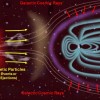
The Earth’s magnetosphere protects us from the harmful charged particles from the solar wind and from cosmic rays originating beyond the Sun. The International Space Station sits within the protection of Earth’s magnetic field so the charged particles capable of damaging DNA and causing cancer are largely kept out, though astronauts on the station still receive higher radiation doses than people on the ground. Astronauts in a spacecraft for a prolonged period of time who travel beyond the safety of Earth’s magnetosphere, however, must face the dangers of exposure.
How Do Magnets Protect Against Radiation?
Developments in magnetics might help remove the threat of overexposure as we attempt further exploration in space travel. Researchers are testing two methods of shielding: passive and active shielding. Passive shielding involves using a material capable of absorbing harmful radiation while active shielding repels the radiation using a magnetic field.
Simulating a magnetic field like the one protecting Earth seems like an effective solution. Superconducting magnets are capable of deflecting radiation. A magnetic radiation shield for a spacecraft was once dismissed as unrealistically expensive, because shielding a large enough region would have required impractically powerful magnets. With developments in superconducting magnets, however, researchers are studying high-temperature superconductors that need less demanding cooling than liquid-helium magnets, although they still require cryogenic cooling. The shield would function like Earth’s by deflecting charged particles away from the spacecraft. A magnetic field bends the path of charged particles through the Lorentz force, so it steers them away rather than separating electrons and protons.
Researchers and engineers are still working on developing a reliable magnetic radiation shield. Other methods of active shielding using simulated magnetic fields are also underway. One of these projects involves magnetic bubbles. One proposal, a "mini-magnetosphere," would surround a spacecraft with a magnetic field and plasma. This would form a bubble roughly 100-200 m across that deflects the charged particles of the solar wind, though it would not stop the highest-energy cosmic rays. What do you think is the best method for protecting against radiation in space? Please leave a comment!
-
Magnetic Pole Searcher/Finder

- 1 North/South Pole Magnet Identifier
- The unit consists of a small alnico bar magnet that is gimbal mounted
- SKU# MPS
$10.99 -
3/4 x 1/8 Inch North Pole Marked Neodymium Disc Magnet N48 (10 Pack)

- 3/4" × 1/8" · 19.05 × 3.18 mm
- 11.1 lb pull per magnetpull each
- 10 magnets10 pcs
- SKU M34x18NDI
per pack · $1.50 per magnet$14.99 As low as $10.49