
Electromagnetic Induction and Tesla Coils: How It Works
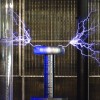
Nikola Tesla is known as one of the greatest minds in science. His experiments helped to further the fields of electricity and magnetism, making many of the gadgets and luxuries we enjoy today possible. One of Tesla’s most well-known inventions is the Tesla coil, a resonant air-core transformer that Tesla used to produce very high voltages and to experiment with wireless transmission of power and signals. The coil was created in 1891.
Today, Tesla coils are mostly found in laboratories and science demonstrations, and similar resonant circuits have been used in radio and television equipment.
How does the Tesla coil work?
There are 6 main components of a Tesla coil: spark gap, capacitor, transformer, primary coil, secondary coil, and top load. The primary circuit has a capacitor, which the transformer charges and which discharges through the spark gap into the primary coil. The secondary coil has no separate capacitor, and its capacitance comes mainly from its top load. The spark gap is a space between two electrical conductors in which a “spark” passes. Spark plugs in a car have the gap, which helps to ignite fuel in engines.
The diagram below shows the basic structure of the Tesla coil and its components. The torus is the top load.


Tesla Coil Experiments
There are dozens of variations for how to create your own Tesla coil. However, constructing one can be a dangerous experiment, because the high voltages involved can be lethal. Only adults should attempt the construction and should do so in a large, open, well-ventilated space like a garage or workshop, away from flammable materials, people and electronics, wearing protective gear and following specified safety precautions.
Here are some of the supplies that you would need to create a simple experiment, learning about this magnificent invention, electricity and electromagnetic induction.
Supplies
- PVC pipe (about 4 feet)
- Transformer/power source
- Wood (for base and spark gap)
- Copper wire
- Capacitor
- Nuts and bolts for spark gap
- Torus
Basic Structure
Two pieces of wood would serve as the base for your coil. In between the two pieces would be the transformer, capacitor, and spark gap. You can make your own capacitor with a leyden jar. The secondary coil is the copper wire wrapped around the PVC pipe. The primary coil is also copper wire, wrapped around a spiral shape. The transformer/power source is connected to the primary coil. The transformer should not be turned on, until after everything is set up and you are a safe distance away. When everything is set and the transformer is turned on the primary circuit oscillates and the secondary coil builds up very high voltage at the top-load or torus, which discharges into the air as streamers that some see as “lightning bolts”.
The Tesla coil works because of electromagnetic induction. This is when a changing magnetic field causes an electric current to flow. If you know about electromagnets, you know that when electric current is applied to copper wire, it becomes like a magnet, generating its own magnetic field.
-
1/2 Inch Neodymium Sphere Magnet N48 (4 Pack)

- 1/2" diameter · 12.7 mm
- 7.38 lb pull per magnetpull each
- 4 magnets4 pcs
- SKU M12SP
per pack · $4.50 per magnet$17.99 As low as $12.59 -
Pyrolytic Graphite Magnetic Levitation Kit

- Complete kit to demonstrate diamagnetic levitation.
- Includes (4) 1/2x1/2x1/4 Neodymium block magnets and (1) piece of 1cm x 1cm x 05.mm pyrolytic graphite.
- Pyrolytic graphite is a unique form of graphite produced by decomposition of a hydrocarbon gas, typically methane, at very high temperature in a vacuum furnace, resulting in an ultra-pure product near theoretical density and extremely anisotropic
- SKU# PGMLK
$39.99 -
Gauss Spectrum Magnetic Field Viewer Film - 8 x 11.75
- 1 Piece Gauss Spectrum Magnetic Field Viewer Film
- Display relative gauss strength in a spectrum of color
- SKU# GSVF
$54.99 As low as $46.74