
Magnetism Helps Prove Lightning's Role In Shaping Mountains
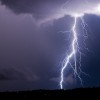
The Earth forms mountains in several different ways, but according to BBC, one of the main ways is when the planet's plates come together. During this process, the Earth's crust succumbs to tremendous forces which makes mountains rise. This is just one example of how mountains are formed, but they are shaped in a variety of ways as well. Lightning strikes, for instance, can play a role in the creation of a mountain's unique profile. Researchers have presented evidence for lightning's role in shaping mountains in a study by Jasper Knight and Stefan Grab published in the journal Geomorphology, thanks in part to magnetism.
Exploding Rocks
Southern Africa is where you'll find the Drakensberg mountain range, which is known for its pinnacles and angular blocks. To find out how these stunning formations came to be, Jasper Knight and Stefan Grab, two professors from the School of Geography, Archaeology and Environmental Studies at the University of the Witwatersrand, Johannesburg, conducted a study.
Based on their research, the professors believe that lightning strikes caused rocks atop the mountain range to explode, which gave the Drakensberg its unique appearance. This challenges the theory that the mountains have slowly changed shape over time due to low temperatures.
"This evidence suggests that that is completely wrong," Knight said in a statement. "African mountain landscapes sometimes evolve very quickly and very dramatically over short periods of time. These are actually very sensitive environments and we need to know more about them."
The Role Magnetism Has
To learn more about lightning's role in shaping the Drakensberg, the professors used a compass. That's because the needle on a compass will make a sudden swing when it passes over rock that has been struck by lightning.
A hot lightning strike can partially melt the rock for a short time, and the rock then cools. As it solidifies, it takes on the magnetic imprint of the Earth's current magnetic field.
"A compass needle always points to magnetic north," said Knight. "But when you pass a compass over a land's surface, if the minerals in the rock have a strong enough magnetic field, the compass will read the magnetic field of the rock, which corresponds to when it was formed. In the Drakensberg, there are a lot of basalt rocks, which contain a lot of magnetic minerals, so they've got a very strong magnetic signal."
Lightning strikes don't play a role in the creation of neodymium magnets, lodestones, naturally magnetized magnetite, were among the earliest known magnetic materials. Read about it here!
Get The Latest Magnetic News With Apex
We are constantly on the lookout for new magnet discoveries. To be in the know about magnetism, magnetic breakthroughs, and industry news (as well as getting occasional discounts), subscribe to our newsletter, or check out our blog.
-
Ferrofluid Magnetic Liquid ***1 Ounce***

- 1oz bottle of Ferrofluid
- This liquid responds to magnets and magnetic fields
- Mineral oil based product
- SKU# FF1oz
$20.99 As low as $16.79 -
1/2 Inch Neodymium Sphere Magnet N48 (4 Pack)

- 1/2" diameter · 12.7 mm
- 7.38 lb pull per magnetpull each
- 4 magnets4 pcs
- SKU M12SP
per pack · $4.50 per magnet$17.99 As low as $12.59 -
Pyrolytic Graphite Magnetic Levitation Kit

- Complete kit to demonstrate diamagnetic levitation.
- Includes (4) 1/2x1/2x1/4 Neodymium block magnets and (1) piece of 1cm x 1cm x 05.mm pyrolytic graphite.
- Pyrolytic graphite is a unique form of graphite produced by decomposition of a hydrocarbon gas, typically methane, at very high temperature in a vacuum furnace, resulting in an ultra-pure product near theoretical density and extremely anisotropic
- SKU# PGMLK
$39.99