
Magnets and Diamonds: What’s The Connection?
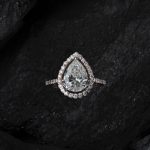
If you own a piece of diamond jewelry, you may be curious to know if it is a naturally occurring or lab-created diamond. A magnet can give you a quick, informal clue before you consult a jeweler, though it can't give a definitive answer.
Naturally occurring diamonds are formed when carbon deposits found deep in the earth are subjected to extreme temperatures and pressure, while lab diamonds are created using similar concepts and a little help from scientists. The majority of all lab diamonds in the world are created using two methods: the HPHT (High-Pressure High Temperature) method or the CVD (Chemical Vapor Deposition) method.
How Lab Diamonds Are Created
First introduced in the 1950s, HPHT diamonds are created by placing a small diamond seed in carbon, along with a molten metal catalyst (typically iron, nickel, or cobalt), and exposing it to extreme heat and pressure. While many still consider such “man-made” processes to be a dupe, these impressive diamonds are nearly identical to naturally occurring diamonds both physically and chemically.
One of the most notable differences between these incredible look-alikes and naturally occurring diamonds is their metallic content. Because HPHT growth relies on metal catalysts, HPHT diamonds can contain tiny metallic inclusions (i.e., non-diamond material trapped in the diamond during formation), which typically look dark and can make a stone weakly magnetic. Many HPHT stones also show a yellow hue from nitrogen present during growth, though modern producers can make colorless stones.
CVD diamonds are similar, however, they use a far different method: a carbon-containing gas, typically methane, is broken down in a vacuum chamber and carbon atoms build up layer by layer on a diamond seed. CVD diamonds don't typically contain metallic inclusions like HPHT diamonds do, so they generally aren't attracted to magnets. It is also worth mentioning that cubic zirconia is a diamond simulant (a different material altogether) and isn't attracted to a magnet either, so a magnet cannot tell it apart from a real diamond.
Put Your Diamonds to The Test
If we have sparked your curiosity to see if that diamond ring is real, try this simple trick. Take a neodymium magnet, we recommend a 1/2" x 1/4" x 1/4" Bar Magnet, and bring it near your diamond, ideally a loose stone, since metal in a ring setting could give a false reading. A natural diamond will typically show no attraction, although a rare natural stone with iron-bearing inclusions might. An HPHT lab-created diamond with enough metallic inclusions may show a weak attraction, which can be very slight in a small stone. Note that not all HPHT diamonds are created equally. The amount of inclusions differs, and many HPHT stones show no attraction at all. No attraction therefore doesn't prove a diamond is natural, since CVD and many HPHT stones won't react either. The magnet test can rule some stones out, but it is not foolproof. For a definitive answer, ask a gemological lab. It is still a fun way to explore your diamonds at home!
Discover The World Around You With APEX!
Whether you’re testing that old family heirloom ring or using magnets to organize your office, there is no limit to what you can accomplish with a bit of ingenuity and a great magnet! For more magnetic fun, check out our blog for the latest DIYs, crafts, experiments, and more! With the assistance of our magnetic masters, your next project is sure to be a success! Contact us today!
-
1/2 x 1/4 x 1/4 Inch Neodymium Bar Magnet N48 (10 Pack)

- 1/2" × 1/4" × 1/4" · 12.7 × 6.35 × 6.35 mm · Diametric
- 5.72 lb pull per magnetpull each
- 10 magnets10 pcs
- SKU M12x14x14BR
per pack · $1.10 per magnet$10.99 As low as $7.69 -
1 x 1/2 Inch Neodymium Disc Magnet N48 (2 Pack)

- 1" × 1/2" · 25.4 × 12.7 mm
- 49.8 lb pull per magnetpull each
- 2 magnets2 pcs
- SKU M1x12DI
per pack · $13.50 per magnet$26.99 As low as $18.89