
Studying Honey Bees with Magnets
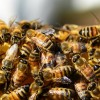
Honey bees need their beauty sleep too, according to an interesting study from the University of Texas. Using magnetism, researchers compared the patterns of well-rested honey bees to sleep-deprived ones and found that lack of sleep affects their communication.
In order to study the bees, Dr. Barrett Klein, an animal behaviorist leading the research, created the “insominator”. Klein attached tiny, magnetic pieces of steel to one group of bees and placed them in a glass walled hive. He then put a panel of magnets on the wall, so that they would move and wake up tired bees. Another group of bees served as the control group, or the well-rested insects, with nonmagnetic attachments.
In the honey bee sleep study, researchers found that a social insect, like bees are affected by lack of sleep in a way that is similar to humans. When humans are sleep-deprived their motor skills and ability to perform is affected.
Bees communicate by doing what is called a “waggle” dance. The dance is very precise and strategic in movement. It tells the other bees that the dancing bee has found nectar. But it can also communicate much more, such as: how far away the nectar is, how much nectar there is, and in what direction it can be found. This is all communicated in the way the bee dances. The sleep-deprived bees were less precise in their waggle dance communication than the ones that were well-rested, signalling that lack of sleep affects insects as well as humans.
Klein’s research may be important in the effort to reduce honey bee colony losses, which remain high: the U.S. Beekeeping Survey (Auburn University, Oregon State University and the Apiary Inspectors of America) found that 39.9% of managed colonies were lost between April 2025 and April 2026. The U.S. Department of Agriculture (USDA) reported winter colony losses of roughly 29% to 36% each year from the 2006/2007 winter through the 2010/2011 winter. Scientists are exploring a number of different factors that could be causing the colony losses. Parasites, pathogens, environmental factors and management stressors are the main categories that they are focusing on. Although, researchers haven’t pointed to a specific cause for the decline, the study shows that management stressors━in this case, sleep deprivation━does affect bee performance. When bees are moved from one location to another, the jostling of transport could disrupt their sleep, although the study did not test this. However, management stressors are only one factor and more research on the cause of the population decline needs to be conducted.
-
1/2 Inch Neodymium Sphere Magnet N48 (4 Pack)

- 1/2" diameter · 12.7 mm
- 7.38 lb pull per magnetpull each
- 4 magnets4 pcs
- SKU M12SP
per pack · $4.50 per magnet$17.99 As low as $12.59 -
Pyrolytic Graphite Magnetic Levitation Kit

- Complete kit to demonstrate diamagnetic levitation.
- Includes (4) 1/2x1/2x1/4 Neodymium block magnets and (1) piece of 1cm x 1cm x 05.mm pyrolytic graphite.
- Pyrolytic graphite is a unique form of graphite produced by decomposition of a hydrocarbon gas, typically methane, at very high temperature in a vacuum furnace, resulting in an ultra-pure product near theoretical density and extremely anisotropic
- SKU# PGMLK
$39.99