
Tiny Magnets Save Shipwrecks
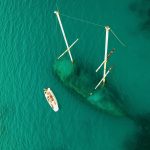
Of the famous shipwrecks in the world, not many have been able to be recovered from their watery graveyards. The RMS Titanic still rests about 12,500 feet below the surface where she fell. The RMS Republic, sunk in 1909 with millions of dollars worth of treasure in its vaults after colliding with the SS Florida off the coast of Nantucket, still rests 250 feet under water. One famous wreck, however, has been raised from her resting place just north of the Isle of Wight: The Mary Rose. Her rise to the surface might just be her demise, though.
History of the Mary Rose
Henry VIII commissioned the building of two vessels to begin his “Army of the Sea” in 1510 one of which being the Mary Rose. While it’s commonly believed that the Mary Rose was sunk on her maiden voyage, she actually served 34 years as a successful warship for Henry VIII before being sunk. After participating in two French wars, the Mary Rose was put into reserve from 1522 to 1535 as she wasn’t particularly economical to operate especially in battle.
In 1545, the Mary Rose set off into the third French war and what would be her final voyage. In the summer of 1545, the English fleet gathered at Portsmouth and prepared to oppose the French as they entered the Solent. The English only had 80 ships to place opposite the French’s 225 ships and retreated into the Portsmouth Harbor to keep them in sheltered waters.
However on the morning of July 19th, according to the French, the French galleys began an assault in an attempt to lure the English into range of their main fleet. The French believed their galleys had sunk her, but the exact cause is still debated: the Mary Rose heeled over and sank, and other accounts point to factors such as open gunports and a sudden wind.
Recovery
While many attempts were made to raise the ship, none were successful until 1982. After resting for 437 years under several meters worth of silt at the bottom of the Solent, around 40% of the hull, 19,000 artifacts, and pieces of timber were able to be preserved. She now rests at the museum in Portsmouth where she and her many artifacts can be viewed.
Since the Mary Rose rested for so long under a deep layer of silt, much of her remains intact. However, when marine bacteria feasts on wood, and iron (fittings, cannons, various artifacts) begins to corrode, ions are released that react with one another. While this isn’t a problem under meters of silt, once brought to the surface, the reaction to oxygen can trigger the production of sulfate salts and sulfuric acid which eats away at the wood and any artifacts that are in contact with iron.
Preserving for the Future
To preserve the previously submerged wood, conservators sprayed the hull with polyethylene glycol (PEG) for 19 years, until April 2013, to fill and strengthen the cells of the wood to prevent shrinking, warping, and cracking as it dried. Once the wood began to dry, oxidized sulfur became the real problem. Researchers have since developed custom-made nanoparticles as a promising treatment; in 2018 reports, the technique had been shown to work on modern wood soaked in iron sulfate but had not yet been tested on Mary Rose timber. While many magnetic materials have their own magnetic field and in turn, their own polarity, these particles are so small (10nm across) that their magnetic fields are easily influenced by an outside magnetic field. This allows the particles to be directed and controlled. Each particle is bound to molecules of porphyrin which will be bound to free ions in the wood. This prevents them from reacting and forming damaging acids. The entire composite is then liquefied, soaking into the wood and carrying the nanoparticles with it. Conservationists are then able to control the composite, capturing iron ions in the process. The whole endeavor removes iron without damaging the wood.
This is a huge step forward for the preservation of priceless artifacts, and magnets are to thank! We’re pleased to see that conservation work on the Mary Rose continues. Keep your eyes on our News & How-To’s section or subscribe to our monthly newsletter for more magnet-related news and DIYs.
-
1/2 Inch Neodymium Sphere Magnet N48 (4 Pack)

- 1/2" diameter · 12.7 mm
- 7.38 lb pull per magnetpull each
- 4 magnets4 pcs
- SKU M12SP
per pack · $4.50 per magnet$17.99 As low as $12.59 -
Pyrolytic Graphite Magnetic Levitation Kit

- Complete kit to demonstrate diamagnetic levitation.
- Includes (4) 1/2x1/2x1/4 Neodymium block magnets and (1) piece of 1cm x 1cm x 05.mm pyrolytic graphite.
- Pyrolytic graphite is a unique form of graphite produced by decomposition of a hydrocarbon gas, typically methane, at very high temperature in a vacuum furnace, resulting in an ultra-pure product near theoretical density and extremely anisotropic
- SKU# PGMLK
$39.99